In 2019, an anonymous user on a conservative investing forum posted a strategy called "Hedgefundie's Excellent Adventure" (HFEA). The pitch was intoxicating: by using a specific mix of 3x leveraged exchange-traded funds (ETFs), a regular retail investor could mimic the high-octane returns of a Wall Street hedge fund.
It worked brilliantly. For a few years, retail traders—some as young as 18 opening their first accounts—were posting screenshots of staggering, life-changing wealth.
Then 2022 happened.
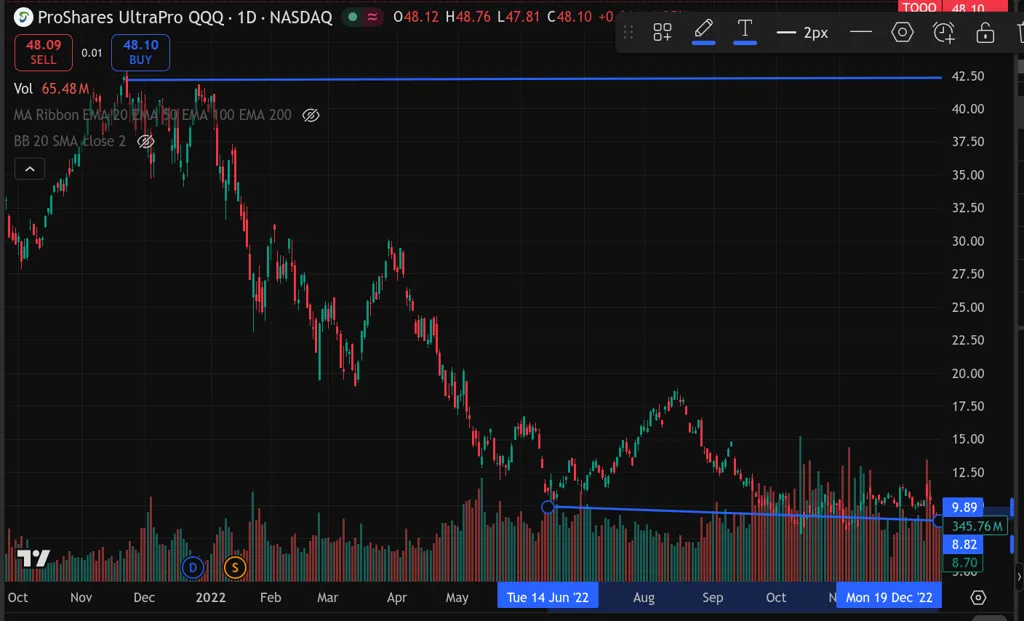
Inflation spiked, interest rates soared, and the fundamental assumption of the strategy broke. By mid-2022, while normal retirement portfolios were down a painful but manageable 12%, the "Hedgefundie" portfolios had suffered devastating drawdowns exceeding 42%. Years of compounding wealth evaporated in months.
Welcome to the double-edged sword of financial leverage.
Today, you don't need to be a Wall Street insider to borrow money to trade. With a few clicks on your brokerage app, you can buy Leveraged ETFs (LETFs) that multiply the daily movements of the stock market. But if you don't understand the hidden math behind these products, they aren't instruments of wealth—they are agents of financial destruction.
Let's break down exactly how leverage works, why the math is secretly working against you, and the only proven, systematic way to use it without losing your shirt.
The Lure of the 3x ETF
For a beginner, an ETF (Exchange Traded Fund) is simply a basket of stocks you can buy all at once. If you buy an S&P 500 ETF, you own a tiny piece of the 500 largest US companies. It's safe, boring, and highly recommended.
But what if you are young, have a small account, and want to get rich faster?
Enter the Leveraged ETF. Funds like UPRO (3x the S&P 500) or TQQQ (3x the tech-heavy Nasdaq-100) promise to triple the daily return of the market. If the Nasdaq goes up 1% today, TQQQ goes up 3%.
When new investors discover this, they inevitably ask the same question:
"Should I just DCA into TQQQ?"
DCA stands for Dollar Cost Averaging—the classic strategy of blindly buying a set amount of a stock every single month, regardless of whether the market is up or down.
The logic seems sound: The stock market always goes up over the long term, right? So if I just buy a 3x leveraged ETF every month and hold it for 20 years, I'll have 3x the money!
The answer is a definitive, mathematical NO.
To understand why a blind buy-and-hold strategy with leveraged ETFs is practically a suicide mission, we have to talk about a silent killer called Volatility Drag (also known as volatility decay).
The Physics of Leverage: Why Math is Against You
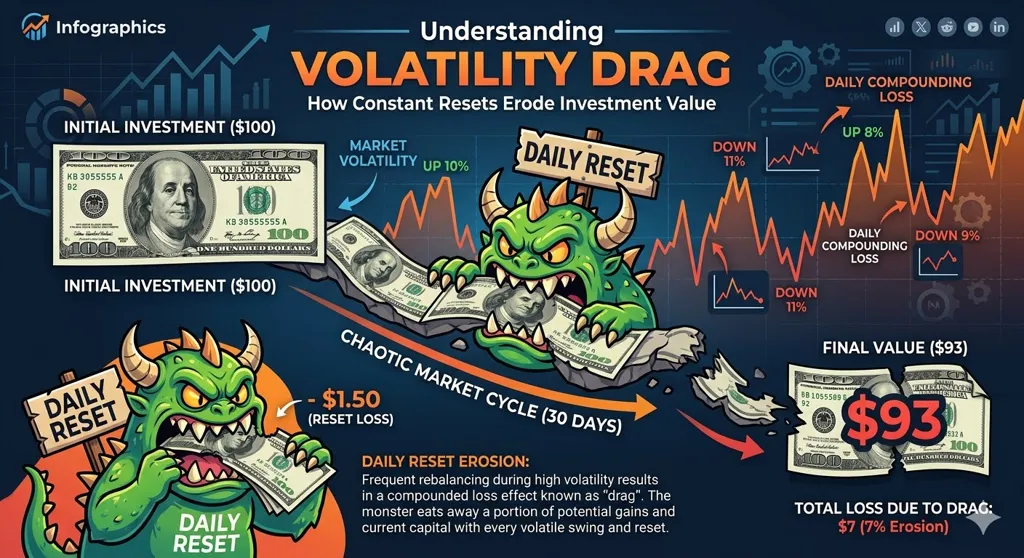
Leveraged ETFs like TQQQ reset their exposure every single day to maintain that 3x target. This creates a trap known as "path dependency."
Let’s look at a simple math example. Imagine an index starts at $100.
-
Day 1: The index drops 10%. It is now worth $90.
-
Day 2: The index rebounds and goes up 11.11%. It is now back to exactly $100. The normal index broke even. You lost nothing. But what happened to your 3x Leveraged ETF?
-
Day 1: The index dropped 10%, so your 3x ETF dropped 30%. Your $100 is now $70.
-
Day 2: The index went up 11.11%, so your 3x ETF goes up 33.33%.
-
The Trap: 33.33% of your depleted $70 capital base is only $23.33. Your total is now $93.33. The market went absolutely nowhere, yet you suffered a permanent 6.67% loss of your capital.
This geometric decay mandates that a leveraged asset must achieve exceptionally high, straight-line returns simply to offset this compounding penalty. In a choppy, sideways, or highly volatile market, a 3x ETF will literally eat itself alive. During the last major bear market, while the normal Nasdaq dropped roughly 30%, the 3x leveraged TQQQ suffered a catastrophic -81% drawdown.
When you lose 81% of your money, you need a 400% gain just to get back to zero.
Leverage for the Long Run: The Right Way to Play
If blind holding guarantees eventual destruction, how do you actually use leverage?
The definitive answer comes from a famous 2016 financial paper by Michael Gayed and Charlie Bilello titled "Leverage for the Long Run." Their central thesis is simple but profound: Volatility is the enemy of leverage.
Because volatility drag destroys your money in choppy markets, you should only apply leverage when the market is in a smooth, persistent uptrend with low volatility. But how do you predict that?
You don't predict. You follow the trend.
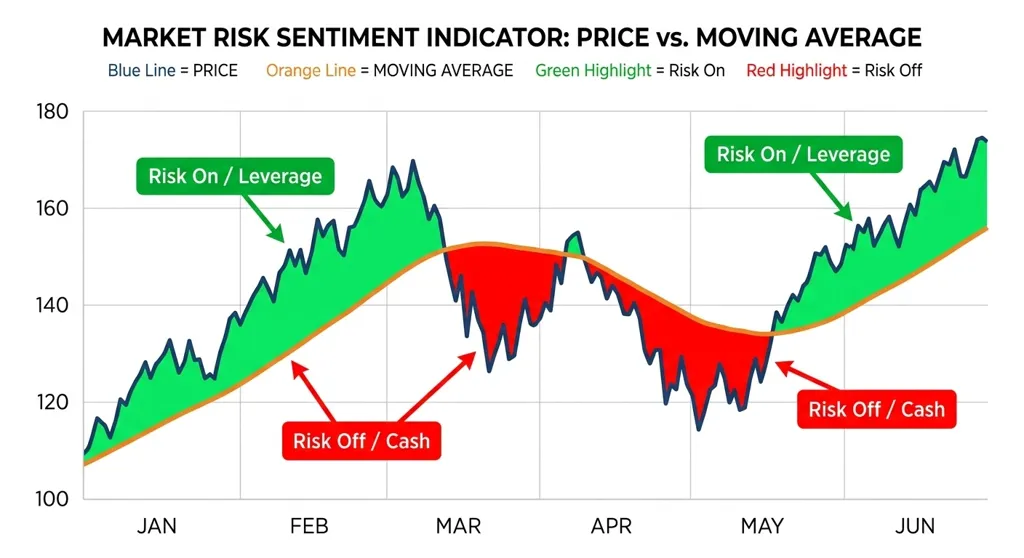
Gayed and Bilello proposed using the 200-day Simple Moving Average (SMA) as a master switch. The 200-day SMA is simply the average price of a stock market index over the last 200 days.
Here is their mechanical, emotion-free system:
- Risk-On: When the broad market (like the S&P 500) closes above its 200-day moving average, the market is historically in a low-volatility uptrend. This is when you buy your 2x or 3x Leveraged ETFs.
- Risk-Off: When the broad market breaks below its 200-day moving average, it signals a transition into a high-volatility, dangerous regime. You immediately sell the leveraged ETF and move to cash or safe treasury bonds. By systematically stepping out of the market during chaotic downturns, you bypass the devastating volatility drag and massive drawdowns that destroy the "buy and hold" leverage traders.
Knowing When to Hit the Brakes
The math is clear: leverage accelerates wealth in an uptrend, but it is the architect of financial ruin in a downtrend. Success requires ruthless, disciplined risk management.
At Eh-Trade, we spent months researching how retail traders blew up their accounts during market corrections. We realized that raw data isn't enough; traders need a built-in safety mechanism.
That's why we built the Market Traffic Light into our dashboard. Instead of asking you to calculate moving averages or track the VIX (the market's fear gauge) yourself, our system continuously monitors the macroeconomic health of the market.
- Green: The trend is smooth. Momentum strategies and leverage have a high mathematical probability of success.
- Red: The market has broken its trend. Volatility is spiking. It is time to step aside, drop the leverage, and protect your capital.
Leverage is a power tool. Used without a guardrail, it will cut your hand off. But if you use strict rules to ensure you only operate in favorable environments, you can stop gambling and start mathematically compounding your wealth.
Comments are disabled.