For the last few years, making money in the stock market felt easy. You could throw a dart at the S&P 500, buy a generic index fund, and watch your account grow. The "Rising Tide" of AI lifted all boats.
But if you’ve looked at your portfolio in early 2026, you might be noticing something frustrating: The index is flat or chopping sideways, yet you see headlines about certain stocks ripping 20%, 30%, or 50% in a month. Meanwhile, other "safe" household names are bleeding out slowly.
What is happening?
Welcome to the era of Market Dispersion.
If you are frustrated by the mixed signals, don't be. This is actually the best possible environment for active traders—if you know how to adapt. Here is why the "Index Fund" strategy is dead for 2026, and why Momentum Investing is the key to unlocking returns in this new market regime.
What is Market Dispersion?
Imagine a highway.
Low Dispersion is like rush hour traffic. Every car is moving at the exact same speed (10 km/h). It doesn't matter if you drive a Ferrari or a Honda Civic; everyone gets there at the same time. This is a "Bull Market" where everything goes up together. In this environment, stock picking is a waste of time. You should just buy the index (the traffic jam) and relax.
High Dispersion is like the Autobahn. Some cars are doing 200 km/h. Others are broken down on the shoulder. The average speed of all cars might still be 100 km/h, but the gap between the fastest car and the slowest car is massive.
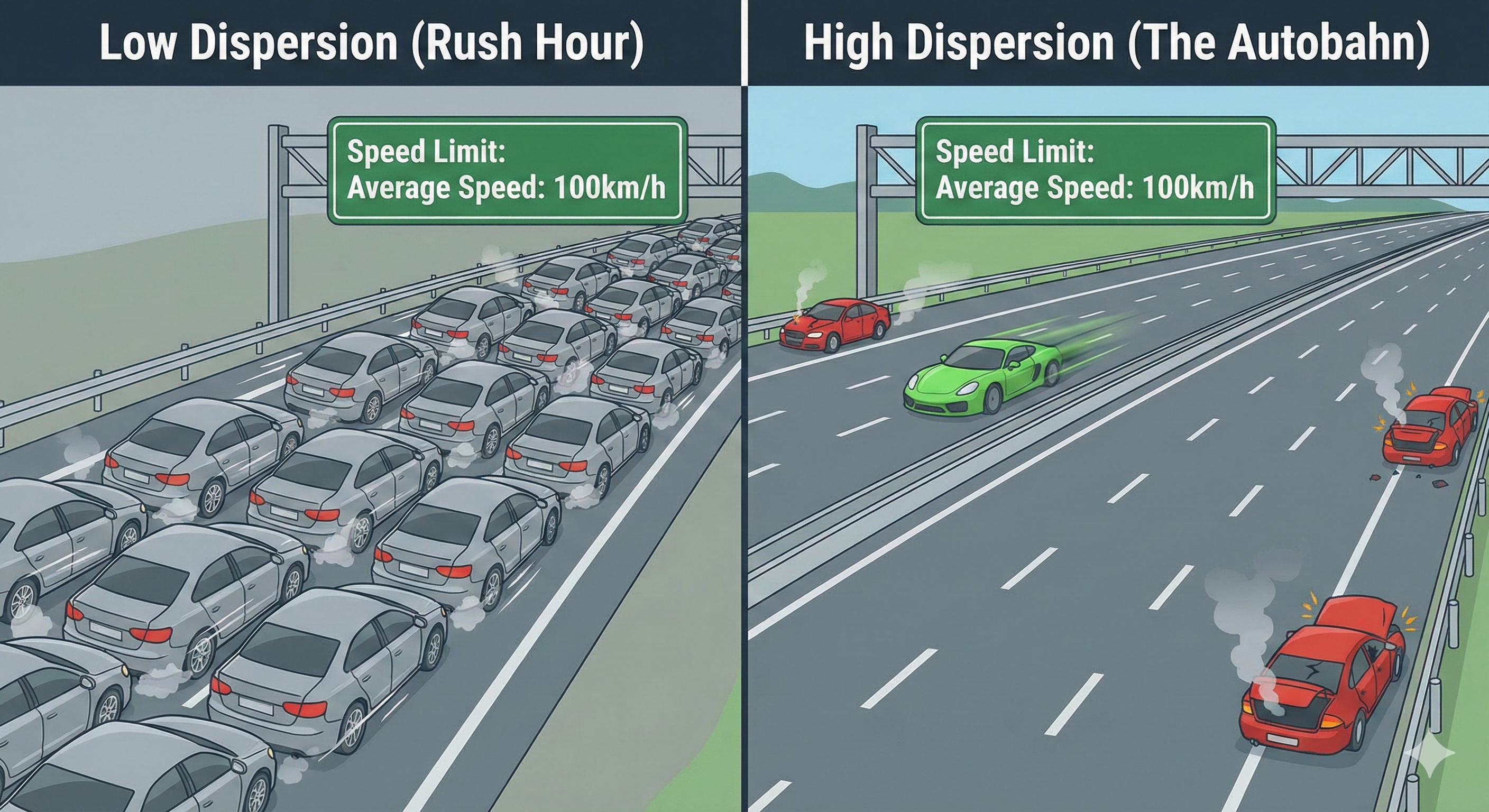
We are currently on the Autobahn. In February 2026, the correlation between stocks has dropped. The "average" return of the market might be boring, but the spread between the winners and losers is at historic highs.
Why Passive Investing Fails in High Dispersion
When dispersion is high, the "Average" becomes a trap.
If you buy an index fund (like SPY or VFV) right now, you are buying the winners and the losers. The solid gains from "boring" sectors like Energy and Consumer Staples are being cancelled out by the sharp sell-off in Big Tech and AI. You end up with a net return of 0%, even though there were massive opportunities right in front of you.
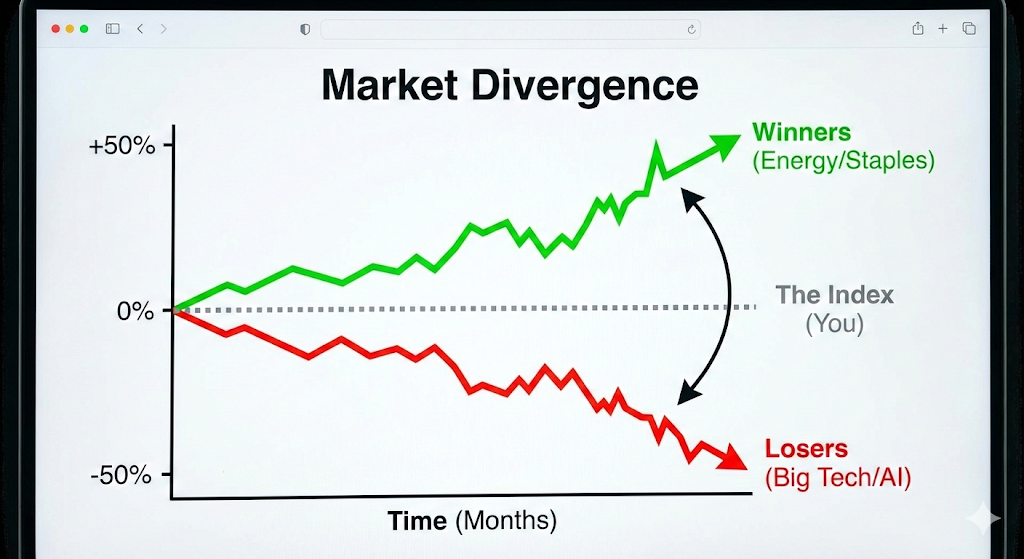
This explains the frustration of the "Value Skeptic": You see "safe" stocks finally moving, but your portfolio is dragged down by the expensive tech stocks you bought last year. In a high dispersion market, the rotation can be brutal if you are on the wrong side of it.
Why Momentum is the "Cheat Code" for Dispersion
This is where Momentum Investing shines.
Momentum strategies don't care about narratives. They don't care if AI is "the future" or if Oil is "dead." They care about Relative Strength.
A momentum strategy effectively says: "I don't want to own the whole highway. I only want to own the cars moving faster than 100 km/h."
In a high dispersion environment, a momentum screener acts as a filter. It automatically strips out the "broken down cars" (currently the struggling Tech and Discretionary stocks) and surfaces only the stocks that are attracting institutional capital (currently Energy, Industrials, and Staples).
The Math of the Winner's Edge
Research from S&P Global and Northern Trust confirms this: Active managers and stock pickers consistently outperform passive index funds during periods of high dispersion. Why? Because the "cost" of holding a loser is so much higher when the winners are running so fast.
How to Trade Dispersion with Eh-Trade
We built Eh-Trade specifically for this environment. We knew the "easy mode" of 2025 wouldn't last forever. Here is how you can use our tools to exploit market dispersion right now:
1. Stop Buying the Haystack (Use the Screener)
Don't just buy "The Market." Use the Eh-Trade Screener to filter for High Momentum stocks. You immediately eliminate the bottom 80% of the market that is chopping sideways or falling. You are now looking at the "Ferraris."
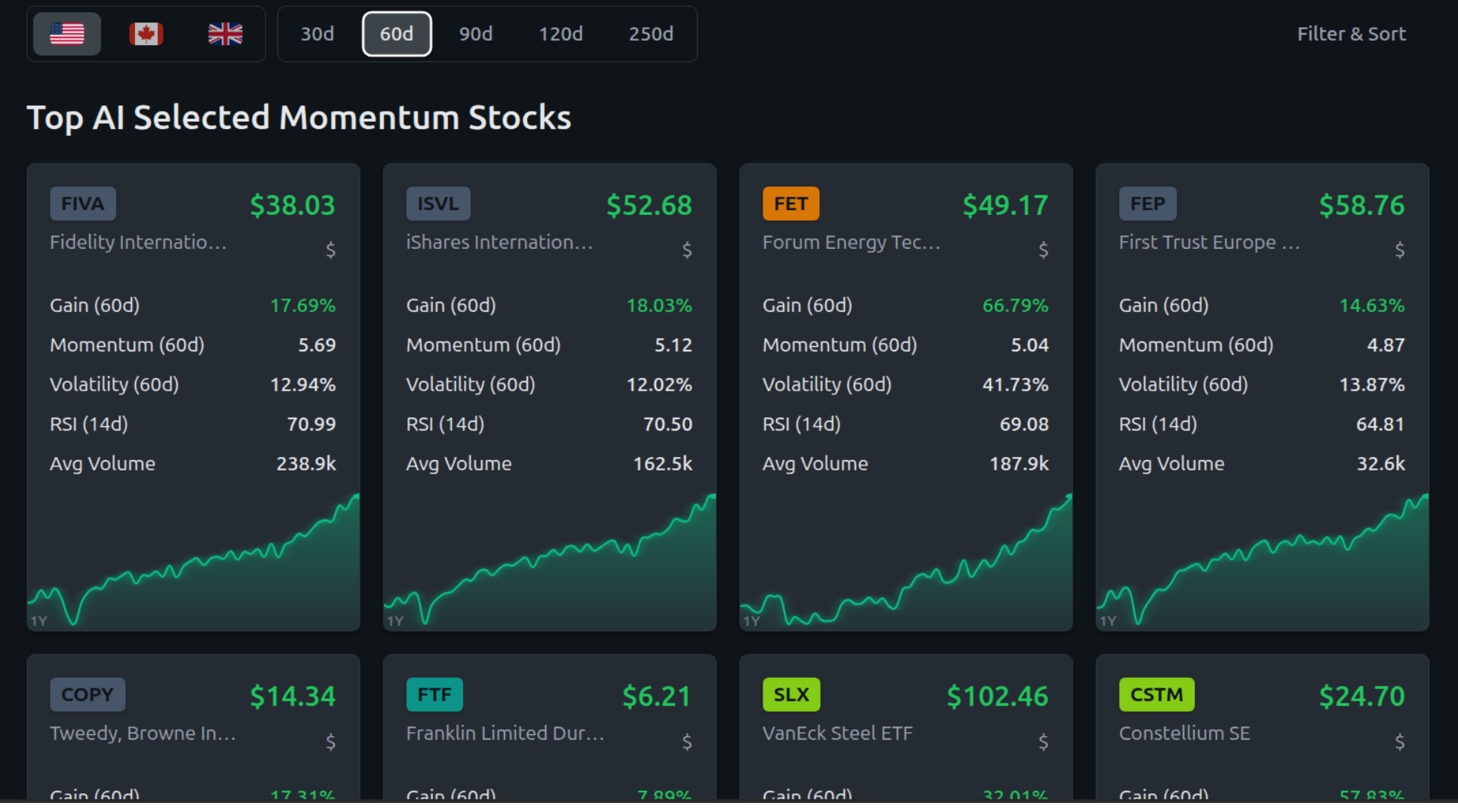
2. Check the "Health Score" (Avoid the Crash)
High dispersion can be volatile. You need to know if a sector is moving because of real strength or just hype.
-
Action: Look at the Market Traffic Light in the header.
-
Strategy: If it's Green, the dispersion is healthy (broad participation). If it's Yellow, be picky. If it's Red, cash is a position.
3. Use Relative Strength (The Truth Teller) (Coming soon)
Our users asked for this, and we listened. In a dispersed market, you need to know if a stock is actually beating the market, or just drifting with it.
-
Action: Look at the Relative Strength Bar on any stock card.
-
Signal: Is the stock bar (Green) bigger than the SPY bar (Grey)? If yes, that stock is a leader. If the stock is up, but less than the SPY, it's a "laggard"—dump it.
4. Sector Rotation is Key
Dispersion often happens between sectors. Right now, we are seeing a flight to safety: Energy and Industrials are hot, while Tech is cooling off.
- Action: Use the Sector Tags in the screener to see where the heat is. Don't try to be a hero buying the dip in a falling sector. Buy strength in strong sectors.
Conclusion: Don't Fear the Divergence
Many retail investors (and even some pros) get scared when the market splits. They see their favorite tech stocks crashing and think the whole sky is falling.
Don't be scared. Be selective.
Dispersion is the only time where individual traders have a massive advantage over the giant institutional whales who are forced to buy the index. You have the agility to pick the winners—whether that's Oil, Gold, or Toothpaste—and ignore the rest.
Ready to find the leaders? Log in to Eh-Trade.ca and check the Momentum List today. Stop settling for "Average."
Disclaimer: This post is for educational purposes only. Past performance does not guarantee future results. Trading stocks involves risk.
Comments are disabled.