There is an old investing adage that every retail trader knows: "Buy Low, Sell High."
It sounds perfect. It appeals to our bargain-hunting human nature. And for 90% of retail traders, it is a trap.
"Buying Low" often means buying a stock that is broken, losing market share, or facing structural headwinds. In the industry, we call this "catching a falling knife." While you are waiting for that "cheap" stock to turn around, other stocks—the ones hitting new all-time highs—are leaving you in the dust.
This is the core philosophy behind Momentum Investing: The idea that assets performing well will continue to perform well.
At Eh-Trade, we built our entire platform around this concept. But we also know that momentum can be dangerous if you don't have brakes. Here is how institutional momentum strategies work, and how you can apply them using Eh-Trade to find winners without the stress.
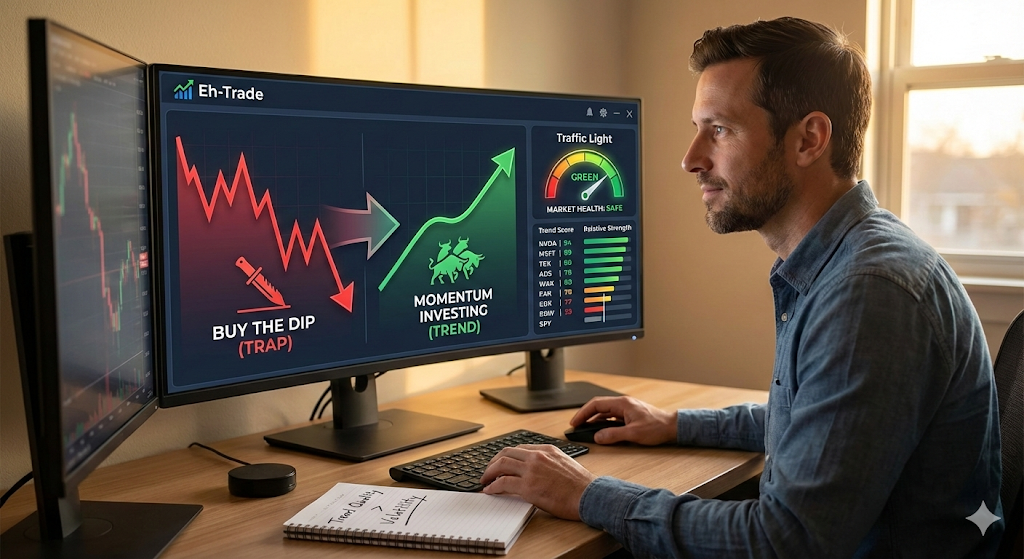
The Physics of the Market: Why Momentum Works
Academic research spanning over 200 years of market data confirms that Momentum is one of the premier factors for generating alpha (returns above the market).
Why? Because of human behavior.
-
Under-reaction: When good news hits a company, investors are skeptical. They buy in slowly. This causes the price to drift up over weeks or months.
-
Herding: As the trend becomes obvious, institutions (Pension Funds, Hedge Funds) pile in. Their massive liquidity drives the price higher, creating a sustained trend.
As a retail trader, your goal isn't to predict the future. Your goal is to identify these "institutional herds" early and ride along with them.
The Problem: Not All Momentum is Created Equal
If momentum is so great, why do retail traders lose money trying to trade it?
Because they confuse "Volatility" with "Momentum."
Imagine two stocks:
-
Stock A jumped 40% yesterday because of a biotech rumor, but was flat for 6 months prior.
-
Stock B has gone up 40% over the last 3 months, moving steadily higher with very few down days.
Most "Top Gainer" lists will show you Stock A. But Stock A is a gamble. Stock B is a Trend.
Retail traders often buy Stock A right at the top, just before it crashes. This is why we built Eh-Trade: to mathematically filter out the noise and find the smooth, high-quality trends.
How to Use Eh-Trade to Find "High Quality" Trends
We don't use simple % gain to rank stocks. We use a proprietary metric called Trend Quality (internally known as TrendSharpe).
Here is the 3-step routine for using the Eh-Trade screener effectively:
Step 1: Check the "Traffic Light" (Market Health)
Before you look at a single ticker, look at the Market Health gauge at the top of your dashboard.
-
Green: The S&P 500 is in an uptrend and volatility (VIX) is low. It is safe to be aggressive.
-
Red: The market is correcting or crashing. Do not buy. Cash is a position.
Strategy Tip: Momentum strategies historically crash when the broad market reverses. If the Traffic Light is Red, sit on your hands. This discipline alone puts you ahead of most traders.
Step 2: Filter by "Trend Score" (Not just % Gain)
In the Eh-Trade screener, look at the Trend Score. This algorithm combines the slope of the trend (how fast it's rising) with the consistency of the trend (how smooth the ride is).
-
We penalize stocks that are too jagged or volatile.
-
We reward stocks that move up in a straight line (High $R^2$).
You are looking for stocks with a Trend Score above 80. These are the stocks that institutions are accumulating steadily.
Step 3: Verify with Relative Strength
We've added a "Relative Strength" bar next to every stock. This compares the stock's performance directly to the S&P 500 (SPY).
-
If the market (SPY) is down -1% this week, but your stock is up +4%, that is a massive signal of strength.
-
It means investors are selling everything else to buy this stock.
When to Sell: The "Brake Pedal"
The hardest part of trading isn't buying; it's selling. Retail traders tend to sell winners too early (for a small profit) and hold losers too long (hoping they come back).
To trade momentum successfully, you must invert this behavior:
-
Cut Losers Fast: If a stock drops below its 20-day or 50-day moving average (visible on our charts), the trend is broken. Get out. Don't ask "why." Just protect your capital.
-
Let Winners Run: As long as the Trend Score remains high and the price stays above the moving average, stay in the trade.
Conclusion
Momentum investing isn't about gambling on penny stocks or guessing earnings reports. It's about using data to identify where the money is flowing right now.
Eh-Trade was designed to give you the same mathematical tools used by quantitative hedge funds, but wrapped in a simple interface that helps you manage risk.
Ready to find your next trend? Sign up for Eh-Trade today.
Disclaimer: This content is for educational purposes only and does not constitute financial advice. Past performance is not indicative of future results. Trading involves risk.
Comments are disabled.