Picture this: It’s early 2024. You’ve got your discounted cash flow (DCF) models open. You’re scanning the market for deeply undervalued equities with solid balance sheets. You spot a legacy industrial company trading at a massive discount to its book value. You buy in, confident that the market is just overreacting to a temporary earnings miss.
Meanwhile, a massive technological paradigm shift is happening in artificial intelligence. You look at the leading semiconductor companies, gasp at their sky-high Price-to-Earnings ratios, and confidently declare them "egregiously overvalued."
Fast forward to mid-2025. That legacy industrial stock? It’s down another 15%, firmly entrenched as a "value trap" because it lacked a catalyst like a spin-off or an activist investor to force price discovery. And those "overvalued" AI stocks? They’ve doubled the return of the S&P 500, leaving you completely on the sidelines of a generational wealth-creation event.
If this scenario makes you wince, you are not alone.

For years, retail investors have been battered over the head with the gospel of value investing: buy cheap, be a contrarian, and wait for mean reversion. But as recent market regimes have proven—especially the extreme divergence between value and momentum in 2024 and 2025—being a pure value purist can sometimes mean missing the boat entirely.
If you are a value investor thinking about dipping your toes into the waters of momentum investing, you need to prepare for a profound psychological rewiring. Here is the research-backed guide to making the transition.
The Overreaction Fallacy vs. The Underreaction Reality
To understand momentum, you first have to unlearn your deepest value investing bias.
Traditional value investing is anchored in the belief that the market overreacts to bad news. When a stock plummets, the conditioned value investor instinctively sees a prime contrarian buying opportunity. But retail trading forums are littered with the financial wreckage of investors who bought into a 10% dip on bad news, only to realize the fundamental catalyst actually warranted a 90% drop. They didn't find value; they caught a falling knife.
Momentum investing requires you to embrace the exact opposite cognitive bias: the market's tendency to underreact to new, positive information.

Why does a stock that just crushed earnings continue to drift upward for months? Because institutional capital is massive, slow-moving, and constrained by rigid risk mandates and committee approvals. When a fundamental shift occurs, major asset managers take months to fully accumulate their required positions. This institutional delay creates a persistent, predictable upward price drift -- one that Eh-Trade is specifically tuned to find.
Momentum investors don't buy stocks just because they are going up; they buy them to exploit this highly predictable institutional lag.
The "Wow, Increasing Revenue" Trap
If you spend any time on "FinTwit" (Financial X), you’ve undoubtedly seen them: the fundamental purists posting complex, beautifully formatted charts projecting quadratically increasing revenues for their favorite beaten-down companies. They argue that the math is undeniable and the market must eventually recognize this underlying fundamental growth.
But here is the bitter pill that momentum investors have already swallowed: fundamentals and actual stock returns are shockingly uncorrelated.
As detailed in the research paper The Alchemy of a Multi-Bagger, a company's fundamental operating performance explains surprisingly little of its stock's price variance over the short-to-medium term. Often, the stocks that generate the most explosive returns do so through pure multiple expansion driven by momentum and narrative, completely divorced from their current balance sheets. The market isn't a purely rational weighing machine in the short term; it's a momentum-driven voting machine shaped by institutional flows.
The 150-Year Proof
It’s easy for fundamental investors to dismiss momentum as pure, chart-chasing speculation. But the academic consensus paints a very different picture.
A seminal study encompassing 150 years of data (from 1866 to 2024) across 46 countries affirms that momentum is a structural, highly robust feature of financial markets. Over that century-and-a-half horizon, a simple strategy of buying past winners and systematically shorting past losers compounded an initial one-dollar investment into over $10,000, delivering annualized gross returns of roughly 8% to 9%.
Momentum isn't a fleeting statistical fluke. It is an empirical reality backed by over a century of data.
A Tale of Transition: Rewiring the Brain
Consider the story of Mark, a retail investor who spent a decade strictly following Warren Buffett's early methodologies. Mark’s portfolio was filled with low P/E, high-dividend yield companies. When the market favored value (like the post-dot-com era), Mark did well.
But during the prolonged zero-interest-rate environment of the 2010s, and particularly during the AI infrastructure super-cycle of 2024, Mark’s portfolio severely lagged. He refused to buy stocks hitting all-time highs, assuming they were bound to crash.
Mark’s breakthrough came when he learned about anchor-based momentum. Humans suffer from an anchoring bias—we disproportionately weight reference points like a stock's 52-week high. When a stock hits that high, investors succumb to the "disposition effect," prematurely selling to lock in gains. This artificial selling pressure suppresses the price, preventing it from fully reflecting the company's new, positive fundamentals.
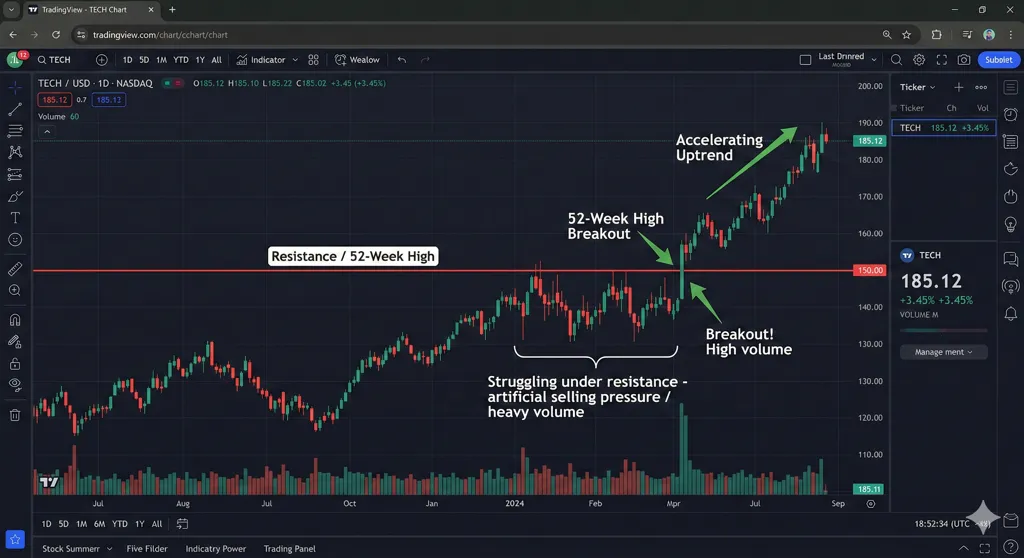
By realizing that a 52-week high is often a buy signal rather than a sell signal, Mark stopped fearing expensive stocks. He learned that buying near the high simply capitalizes on delayed price discovery.
The Recovering Value Investor’s Rulebook
Transitioning from qualitative value analysis to empirical momentum requires rigid, systematic rules to prevent your old value biases from hijacking your portfolio. If you want to trade like a quantitative momentum practitioner, follow these rules:
-
Use Absolute and Relative Momentum: First, evaluate if you should even be in equities by comparing asset classes against a risk-free benchmark (absolute momentum). Then, rank assets within your universe to strictly identify the strongest relative performers.
-
Shorten Your Holding Period: Value investing requires holding assets for years waiting for a corporate restructuring or share buyback program to unlock value. Optimal momentum investing requires holding periods of merely three to four months to ride the institutional drift before the trend exhausts itself.
-
Implement Trend Following Overlays: Momentum carries a severe, well-documented crash risk during sudden macroeconomic regime changes. Protect yourself by using moving average systems. If an asset's price falls below a long-term trendline (like the 10-month simple moving average), mechanically shift that capital to safety.
-
Rebalance Systematically: Implement a disciplined quarterly rebalancing schedule (e.g., the end of February, May, August, and November) to maintain your exposure to the best winners while minimizing emotional interference.
The Ultimate Solution: Why Not Both?
Here is the best news for the transitioning value investor: you don't actually have to abandon your value roots entirely.
Because value and momentum thrive in different macroeconomic environments (e.g., extreme momentum in early 2025, followed by a massive value rotation in late 2025), they have historically negative correlations.
However, quantitative research issues a massive warning: do not blend them into a single metric. Trying to find a single stock that is deeply undervalued and has top-tier price momentum forces you to compromise, leaving you with a portfolio of mediocre stocks.
Instead, empirical backtesting reveals that maintaining pure, separate exposures is superior. A 50/50 allocation to a highly concentrated value portfolio and a highly concentrated momentum portfolio yields higher absolute returns than trying to mix the signals.
So, keep your DCF models. Keep hunting for those deep-value spin-offs and massive share buyback catalysts. But carve out half of your portfolio to systematically buy the winners. Stop fighting the trend, stop trying to catch every falling knife, and let institutional momentum do the heavy lifting for a change.
Comments are disabled.